
This page collects beginner tips and strategy for 2048.
These ideas do not guarantee that you will reach 2048. New tile positions and values are random, so use them as checks when you compare the moves available on your board.
Choose one corner for the largest tile
A board often fills early when large tiles become scattered across the center and several edges, leaving little room to move smaller values.
The first step is not simply making more immediate matches. Keep the largest tile predictable while preserving empty cells.
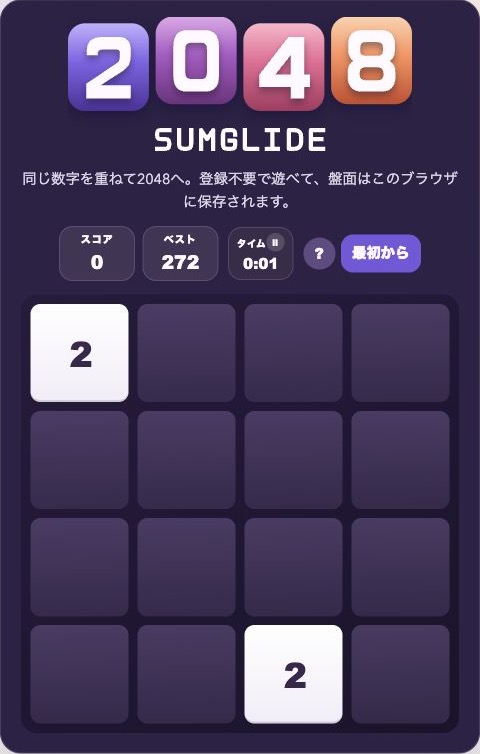
Pick a reference corner, such as the bottom-right or bottom-left. Keeping the largest tile near that corner limits how far your most valuable tile needs to move.
If you choose the bottom-right, favor down and right. Use left when you need to arrange the row. Moving up can pull the largest tile away from the bottom edge, so check whether you can restore the edge before using it repeatedly.
Completely banning the opposite direction can also trap the board. Rather than never using it, ask whether you can return the largest tile to its reference corner afterward.
Build descending values along one edge
A corner tile is not enough when small values keep blocking the cell beside it. Try to arrange the chosen edge so that values descend away from the corner.
For example, reading the bottom edge from the bottom-right, 128 → 64 → 32 → 16 gives each large value a useful neighbor. A second 64 can be prepared for the existing 64, which then supports the next 128. The row does not need to be perfect, but avoid leaving a 2 or 4 between the largest tiles whenever another move can preserve their order.
Check three things before each move
SumGlide 2048 adds one new tile after a move changes the board. A small merge may look useful but leave no more open cells once the new tile appears. Compare possible directions with three questions:
- How many empty cells will remain?
- Will the next move have a matching pair?
- Will the largest tile stay near the chosen corner or edge?
When two moves are available, prefer the one that preserves more space and prepares another pair over a move that only makes one small match.
Recover space before forcing the corner back
When the largest tile leaves its corner, repeatedly pushing it back can collect small values on another edge. Merge smaller values first and create an open route toward the reference corner.
Available space matters more than preserving a perfect pattern. With only one empty cell, a move that creates two or more open cells can be a better recovery than a move that keeps the largest tile fixed.
In closing
These are the basic ideas for approaching a 2048 board. Use them as you play SumGlide 2048.